3D/XR


Job postings often repeat the same clichés about “prime positions” and “dynamic teams,” making it difficult for job seekers to understand what the role—or the company behind it—is really like. This happens because the posting is written from the employer’s perspective. The result? Individual ads get lost in the crowd, and industries trying to boost their appeal often fail to generate enough interest.
To ensure differentiation, we gamified our clients’ recruitment campaigns.
Case 1
Coder AI Quiz / Fonzit Oy
Not all recruitment campaigns aim for large audiences. For many IT companies, the priority is finding the right specialists—those with experience and passion for very specific technologies.
Fonzit Oy wanted to reach experienced software developers, data experts, and software architects. However, a traditional job posting doesn’t always resonate with these seasoned professionals. That’s why the team decided to test a gamified approach: an AI quiz with questions about current technologies and industry trends.
The idea was simple but effective: if a candidate feels that the quiz questions speak to them, their barrier to taking the next step—submitting an open application or reaching out—drops significantly.
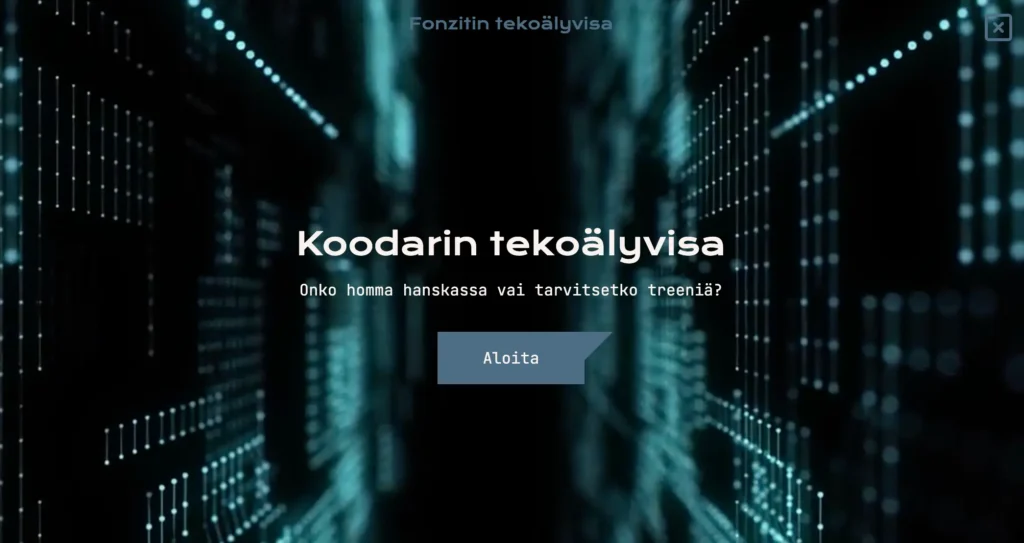
The quiz functioned as a kind of “pre-screening”: it signaled to the player that here, your language and expertise are understood. At the same time, it conveyed the employer’s image as a modern, forward-looking tech company.
In this implementation, gamification was one way to attract attention, but above all, it served to lower the barrier to applying and give candidates the feeling that they would fit in.
Case 2
The Paper Delivery Game / Medialiitto
Medialiitto wanted to raise awareness of newspaper delivery work done at night. The goal was to engage potential employees, especially those aged 18–30. The client wanted a gamified, story-driven solution that highlighted the benefits of the job: it’s active and independent, and night shifts free up the days for hobbies, studies, other jobs, or personal dreams.
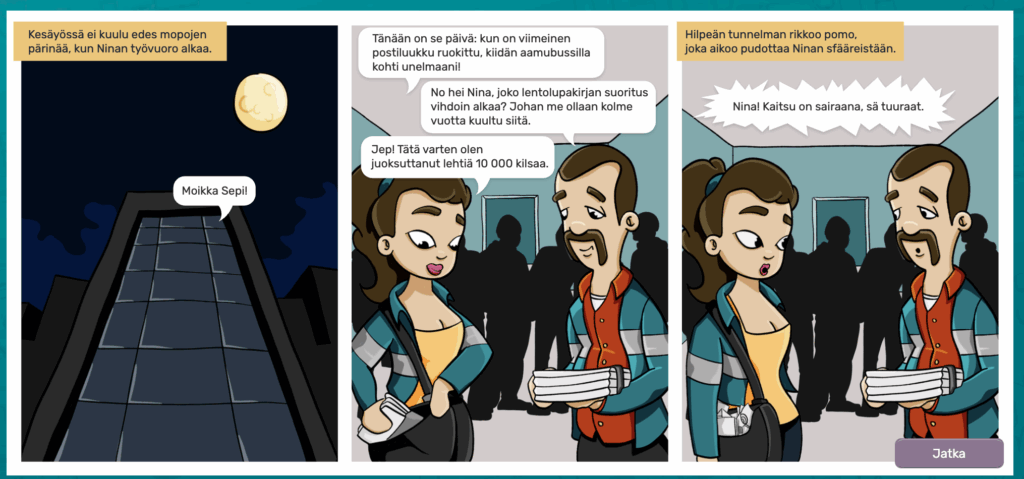
Our team developed a comic-style paper delivery game, where the objective is to deliver a package on time. The main character, Nina, unexpectedly receives an unusual assignment. During her shift, she encounters various challenges that require decision-making. Some choices help her progress, while others slow her down. In the background is Nina’s long-awaited dream, which she needs to reach the first bus in the morning to achieve. But time is running out, and the realization of her dream hangs in the balance…
Because employer branding is built above all on experiences.
Companies invest significant time and resources in how they present themselves as employers, service providers, or brands. This often means carefully crafted texts, slogans, and campaigns. A traditional job posting is a one-way message—the employer tells what they offer and hopes candidates will be convinced.
Games and quizzes, on the other hand, draw candidates in. They get to participate, make choices, and experience what the employer’s world might feel like. Gamification and interactivity are at their best here: static messages turn into an experience that the user is actively part of.
Gamification fundamentally leverages psychological mechanisms that work just as well on students as on experienced professionals:
Too often, gamification is thought to be suitable only for young people, students, or consumer markets. In reality, the same logic works just as well in B2B recruitment and expert-driven fields.
B2B recruitment is often a competition for scarce talent. This is precisely where gamification stands out: it makes the message more approachable, helps concretize what the job is really about, and gives candidates a reason to spend more time engaging with the employer brand. Rather than serving as mere entertainment, a game can be used to communicate complex ideas quickly and in an engaging way.
One of the most common challenges is envisioning what the final result could look like. That’s why we’re happy to showcase different implementations and explain what has been achieved with them.
👉 If you’re interested, we can create a simple concept free of charge alongside the proposal, so you can see what kind of solution it could be.
If you have a need, we have an idea.
Book a time with Monica and let’s have a relaxed, informal chat.
"*" indicates required fields