
AI idea generator helps businesses develop tourism in the Baltic Sea Region
GAMIFICATION
I’m sitting at my desk, clicking through the Light in the Dark project’s idea generator to see how it works. Click, click, and suddenly I feel a warmth spreading through my whole body: now I know what I want to be when I grow up!
My future business will offer luxurious autumn retreats in an old cottage in the archipelago. The target audience? Handicraft aficionados from all over the world. The programme will include knitting, delicious food and star-filled skies so clear they take your breath away.
That’s the kind of idea the digital, AI-powered tool developed by J&Co for Light in the Dark, an Interreg Baltic Sea Region-funded project, can help me come up with. All I had to do was answer a few questions. Click, click, and the idea generator conjured up a plan.
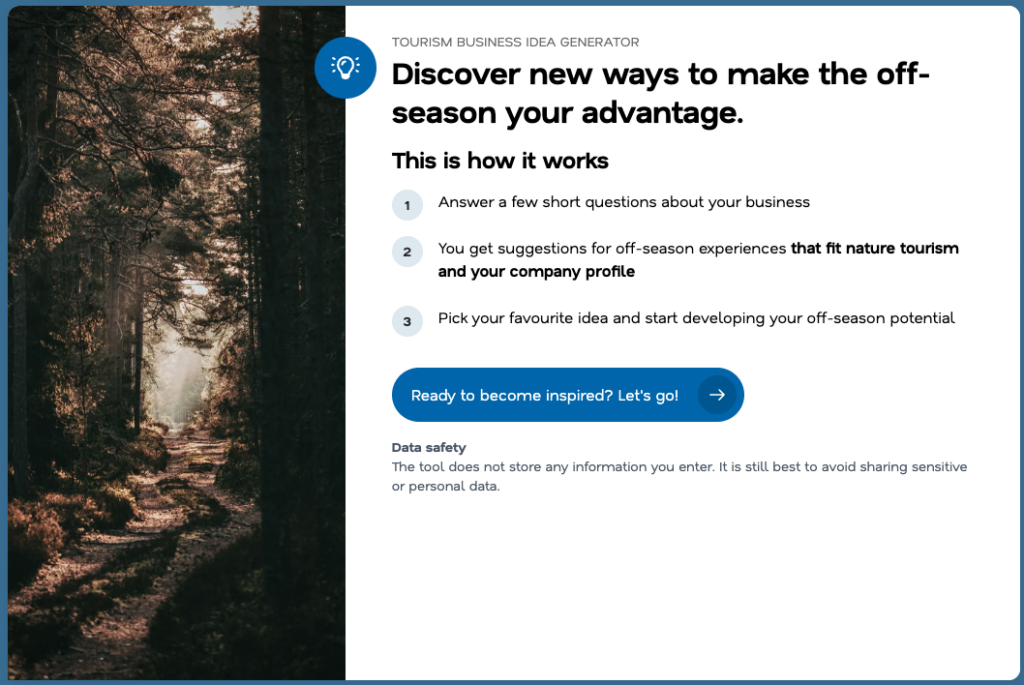
The aim is to inspire
My vision makes both Janina Selin (Novia University of Applied Sciences) and Helena von Schoultz (Åland University of Applied Sciences) laugh. And that is exactly how the digital tool is meant to work: it is designed to inspire.
Both are involved in a cross-border project aimed at extending the tourist season in the Baltic Sea Region. The challenge of a short peak season is shared across the entire region.
“Businesses tell us that, if it’s a good summer, the peak season starts shortly after Midsummer. But here, for example, it often ends as soon as the schools start again,” says Janina. “Extending the tourist season is important because it provides financial support for small businesses and also creates local jobs.”
A digital tool to share knowledge
Fortunately, help is now available. The Light in the Dark project was launched in 2023 with an in-depth study of the challenges faced by small and medium-sized enterprises around the Baltic Sea when it comes to extending the tourist season. The project also set out to explore who nature tourists are, what they want and what they need.
“Early on in the project, a number of selected businesses from all the partner countries took part in a series of workshops, where they received support and guidance in developing new offerings for the low season and for nature tourists,” Helena explains. “The new experiences were then piloted.”
An important part of the project is sharing all the knowledge gathered throughout its activities. Already during the planning stage, it was decided that a digital tool would be one way of doing this.
“During the project, we realised that businesses often struggle to explore our material in depth, partly because they lack the time,” says Janina. “Our digital tool makes the material easily accessible to users and helps it reach a wider audience.”
AI to the rescue
Technology has advanced rapidly during the project, opening up new possibilities for developing the digital tool. The AI-powered idea generator is built around a language model that draws on the material collected by the project.
“It has genuinely been an exciting journey over the past few years. Unlike general-purpose language models, we wanted to create a visually appealing, practical tool that provides useful ideas in an accessible format, without requiring users to have any prior knowledge of the subject. Thanks to our collaboration with J&Co, we’ve succeeded in doing just that,” says Janina.
The collaboration with J&Co has worked well, and both Janina and Helena are particularly grateful for the team’s technical expertise.
“We haven’t had to be tech-savvy ourselves. J&Co has handled that side of things brilliantly,” says Helena.
A key focus of the project has been highlighting existing resources and local strengths.
“If we can help businesses discover what’s available in their local area and make use of it, they may start developing more sustainable experiences for tourists. We don’t always need to create something new; we can make good use of what’s already there. These resources are valuable and worth preserving,” Janina concludes.
ARE YOU IN NEED OF A SIMILAR SOLUTION?


Contact us
"*" indicates required fields